How to Teach Kids About Money: 7 Simple Lessons for Everyday Life
Children begin forming ideas about money long before they understand bank accounts, budgets, or investing.
They watch adults pay for things, hear conversations about prices, and start asking for things they want.
But teaching children about money doesn't need to begin with complicated financial lessons.
Some of the most important lessons can begin with everyday questions:
Do we really need this?
Why does this cost more?
What happens if we save for something?
How do we decide what is worth spending money on?
These simple conversations can help children develop healthy money habits while learning something even more important: how to make thoughtful choices.
Here are seven simple ways parents can teach children about money in everyday life.
1. Start with a Simple Question: What Is Money?
Children see money everywhere, but they may not understand what it actually is.
You can start with a simple idea:
Money is a tool that helps people exchange value.
A baker makes bread. A teacher helps children learn. A shop provides products people need or want. Money helps these exchanges happen more easily.
This doesn't need to become a formal lesson. The next time your child asks why someone gets paid for their work, use the opportunity to talk about how people create value by helping others.
This is the idea behind the first Kinwise session, Why Money Exists—helping children understand money as a tool rather than simply something we use to buy things.
2. Teach the Difference Between Needs and Wants
This is one of the simplest and most powerful foundations for healthy money habits.
During a shopping trip, your child might ask for a toy, snack, or new game.
Instead of simply saying yes or no, try asking:
"Is this something we need, or something we want?"
The goal isn't to teach children that wants are bad.
We all want things that make life more enjoyable.
The important lesson is learning to recognize the difference and understand that spending money on one thing may mean having less money available for something else.
3. Let Children Make Small Choices
Children learn about money by making decisions—not just by hearing adults talk about them.
Give them opportunities to make small, age-appropriate choices.
For example:
"You can choose one of these two snacks."
Or:
"Would you rather spend your ¥500 today or save it for something bigger?"
There doesn't always have to be a perfect answer.
The experience of choosing, considering alternatives, and living with the result is itself valuable.
These small decisions help children develop judgment and understand that resources are limited.
4. Talk About Why Things Cost What They Cost
Children often notice that one toy costs ¥1,000 while another costs ¥5,000.
That's a great opportunity to ask:
"Why do you think this one costs more?"
Talk about materials, time, skills, design, transportation, and the people involved in making and selling a product.
You can even compare something handmade with something mass-produced.
The goal isn't to teach children how companies calculate prices.
It's to help them understand that price and value are connected to many different factors.
Most importantly, children can begin to see that money is connected to work, effort, skills, and value creation.
5. Help Children Learn to Wait
One of the hardest money lessons for children can also be one of the most valuable:
You don't have to buy something immediately just because you want it.
If your child wants something special, help them turn it into a small savings goal.
Instead of simply saying, "You can't afford it," try:
"How could we work toward getting it?"
Saving then becomes more than putting coins into a jar.
It becomes an opportunity to learn patience, planning, and delayed gratification.
Children discover that a choice today can create a different possibility tomorrow.
6. Use Everyday Life Instead of Turning Everything into a Lesson
You don't need to schedule a weekly "money lesson."
Some of the best learning happens naturally.
Planning a family outing can become a conversation about choices.
Comparing prices at the supermarket can become a conversation about value.
Choosing a birthday present can become a conversation about generosity.
Saving for a holiday can become a conversation about planning.
These ordinary moments give children something a textbook cannot: a chance to see ideas in action.
At Kinwise, we believe meaningful learning often begins this way—with a story, an everyday situation, and a conversation between a child and a parent.
7. Teach That Money Decisions Are Human Decisions
Money is not only about earning, spending, and saving.
It is also about values.
How do we decide what is important?
When should we save instead of spend?
Why might we choose to help someone else?
What does "worth it" really mean?
And as children grow up surrounded by increasingly powerful technology and AI, another question becomes important:
Should we always follow the recommendation of a tool simply because it is convenient?
Children will need more than financial knowledge.
They will need judgment, responsibility, and the ability to think about consequences.
These are the deeper skills behind financial responsibility.
Start with a Simple Game
Learning about money doesn’t have to feel like a lesson.
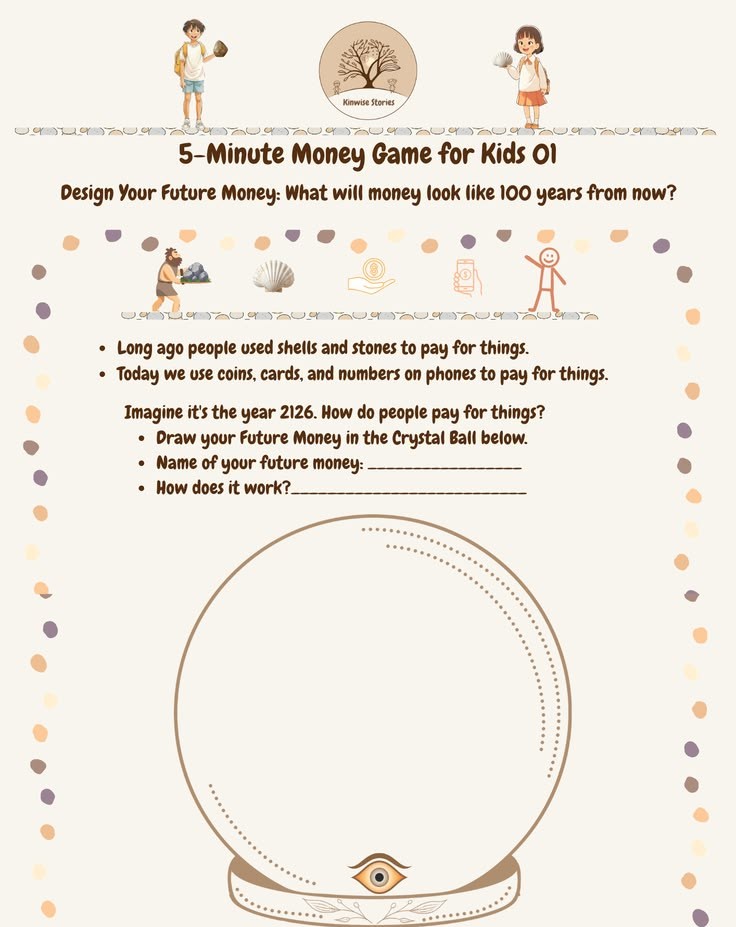
You can start by playing a simple game at home: Design the Future Money.
Imagine your child could design a new kind of money for the future. What would it look like? What could it be used for? What would make it valuable? And what would they want people to use it for?
There are no right or wrong answers.
The goal is to get children thinking about money in a different way — not simply as something to spend, but as a tool connected to choices, value, creativity, people, and the future.
Design the Future Money is a simple 5-minute money game you can play together at home. It gives parents and children a chance to talk, imagine, and think about what money might mean in their lives.
Sometimes, the best way to teach children about money is not to give them another lesson — but to give them a chance to play, imagine, and make their own choices.
Ready to play? Let’s design the future money.